From OBC to Industrial Control: How Does a High-Current Common Mode Inductor Maintain Stable Filtering?

August 12, 2026

Son şirket haberleri hakkında From OBC to Industrial Control: How Does a High-Current Common Mode Inductor Maintain Stable Filtering?

The electrification and intelligence of automobiles are accelerating, and onboard electronic systems are increasing rapidly. From battery management, OBC, to motor drives and smart cockpits, every electronic module can become a source of EMI interference. Vehicles also face diverse global climates – from extreme cold to intense heat. Components must operate reliably over a wide temperature range, typically from -40°C to +105°C or even wider, for extended periods. Common mode inductors are key components for suppressing common-mode noise on power lines. Their performance directly affects whether the system can pass EMC testing, and determines the vehicle's stability in complex electromagnetic environments.

Industry Trends: The Threefold Challenge of Automotive-Grade EMC Components

With the rapid development of new energy vehicles and autonomous driving technologies, onboard electronic systems are facing three major trends:

  • Wide Temperature Range: Power electronics such as OBC and DC-DC converters are often located near the battery or motor, where operating temperatures are much higher than those in traditional automotive electronics. Standards such as AEC-Q200 require passive components to maintain stable performance from -40°C to +125°C.
  • High Voltage Withstand: The 800V platform is gradually becoming mainstream, placing higher demands on component insulation and voltage withstand capability. Common-mode inductors must provide reliable isolation to ensure high-voltage safety.
  • Long Service Life: The typical design life of an automobile is 15 years or 200,000 kilometres. Components must not significantly degrade in performance over this period, requiring exceptional material stability and process reliability.

Product Technical Positioning: Wide Temperature, High Voltage Withstand, Flame Retardant – Three Key Features Precisely Matched to Automotive Requirements

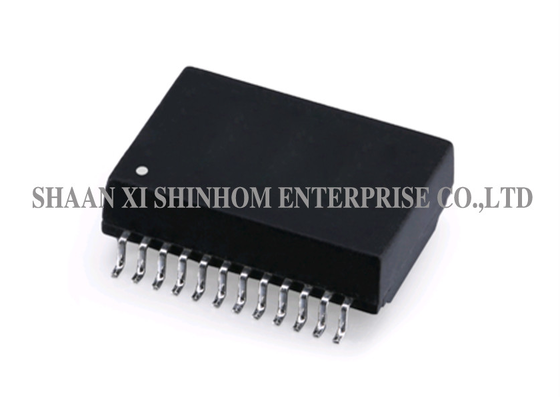
The TRF2606H-103Y common mode inductor is specifically designed to meet the demanding requirements mentioned above. Its key technical specifications are as follows:

Core Parameter Specification Automotive Significance
Operating Temperature -40°C to +105°C Covers the operating environment of most automotive electronic devices, ensuring stable EMI filtering performance under both extreme cold and high-temperature conditions.
Withstand Voltage Isolation 1500VAC (N1 to N2)
1000VAC (Coil to Core)
Meets the safety isolation requirements of 800V high-voltage systems, preventing high-voltage breakdown.
Flame Retardant Rating UL94V-0 Complies with fire safety standards for automotive electronic equipment, reducing fire risk.
Inductance 11.5mH (Min.) Provides sufficient common-mode impedance across a wide frequency range to effectively suppress broadband noise.
Rated Current 4A Meets the current carrying requirements of medium-power applications such as OBC and DC-DC converters.
Low DCR 65mΩ (Max.) Reduces power loss, minimises heat generation, and improves system efficiency.

Conclusion

As automotive electronics evolve towards higher voltages, higher power density, and higher integration, the selection of EMC components is shifting from "meeting basic functionality" to "ensuring reliability throughout the entire lifecycle." With its wide operating temperature range, high isolation voltage withstand, and flame-retardant properties, the TRF2606H-103Y common mode inductor provides a trustworthy EMI filtering solution for high-reliability applications such as automotive electronics and industrial control.

For more technical details or sample testing support, please feel free to contact our technical team.

Bizimle temasa geçin
İlgili kişi : Jack wang
Tel : 13909218465
Faks : 86-029-87851840
Kalan karakter(20/3000)